If you’ve spent any time shopping for a robot vacuum, you’ve run into the Pa number. It’s everywhere — printed in bold on the box, listed first in the spec sheet, plastered across advertising banners. In 2022, a robot vacuum rated at 5,000 Pa was considered a flagship. In 2026, you’ll find budget models advertising 8,000 Pa and premium machines pushing 35,000 Pa or higher.
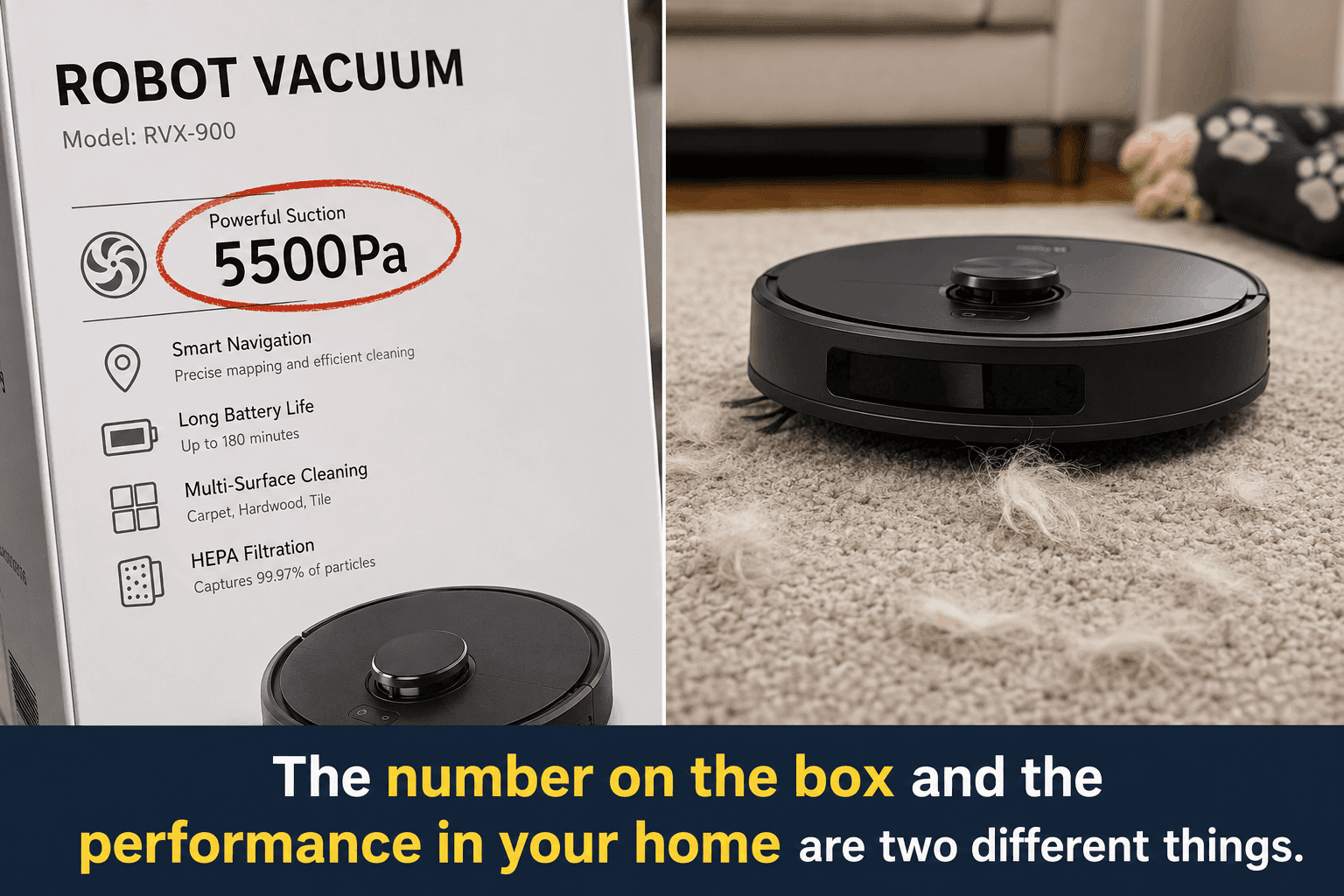
Here’s the thing nobody in the marketing materials will tell you: independent testing consistently shows that a well-engineered 6,000 Pa robot can outclean a poorly designed 18,000 Pa model on the same floor. The Pa number matters — but it tells you far less about real-world cleaning performance than the companies selling these machines would like you to believe.
This guide breaks down what Pa actually means, what it doesn’t measure, why the industry has inflated these numbers dramatically, and — most importantly — exactly how many Pascals you actually need based on what’s in your home.
What Pa Actually Means
Pa stands for Pascal, a scientific unit of pressure named after 17th-century French physicist Blaise Pascal. In the context of a robot vacuum, Pa measures the static suction pressure the motor can generate — essentially, how hard the machine pulls at a single point.
Think of it this way: Pa tells you the squeezing force, not how much air actually flows. A very strong squeeze on a partially blocked straw still moves less liquid than a moderate squeeze through a wide-open tube. The same principle applies inside a vacuum cleaner.
When a manufacturer says their robot generates 10,000 Pa, they mean the motor can produce that level of suction pressure under controlled lab conditions at maximum power. That number is measured at the motor itself — before the air travels through the dustbin, around the filter housing, through the cleaning head, and finally to the floor. By the time suction actually reaches your carpet or hardwood, it has lost a meaningful portion of that rated pressure through the system.
This is the first thing to understand: the Pa on the box is a motor measurement, not a floor measurement.
Why Pa Alone Doesn’t Predict Cleaning Performance
Pa captures one variable in a system that depends on at least four. Understanding all of them explains why a lower-rated robot sometimes outperforms a higher-rated one — and why chasing the biggest number rarely leads to the best result.
Airflow
Pa measures pressure. Airflow measures volume — how much air moves through the system per second. A vacuum needs both: sufficient pressure to lift debris from surfaces, and sufficient airflow to carry that debris through the machine and into the dustbin.
A robot vacuum can have extremely high Pa at the motor while having poor airflow if the internal path is narrow, sharply angled, or leaking. The result is strong localized pressure that doesn’t translate into good debris transport. This is why a robot vacuum rated at 10,000 Pa with poor airflow design can be genuinely outperformed by a 6,000 Pa model with an optimized airflow path.
Brush Roll Design
The brush roll is what makes physical contact with your floor and debris. On carpet especially, the brush’s mechanical agitation — the actual physical action of the roller pressing against and combing through carpet fibers — does as much work as suction in extracting embedded dirt and pet hair.
Suction alone, regardless of Pa rating, cannot lift debris that’s embedded in carpet fibers without a brush roll to loosen it first. This is why brush roll design is just as predictive of carpet cleaning performance as Pa, and why two robots with identical Pa ratings can produce very different results depending on whether they use rubber extractors or bristle brushes, and how the geometry of the roll contacts the floor.
Internal Sealing
Any gap in the vacuum’s internal airpath leaks suction pressure before it reaches the floor. Gaps around dustbin seals, filter housings, and connection joints between components bleed off Pa that the motor is generating. A well-sealed robot rated at 7,000 Pa can deliver more effective floor suction than a poorly sealed 12,000 Pa machine.
This is almost never discussed in product marketing, but it’s cited repeatedly in engineering-level teardown analyses as one of the primary reasons spec-sheet Pa doesn’t match real-world performance.
Filter Condition
A clogged or dirty filter restricts airflow through the system, directly reducing the effective suction reaching the floor regardless of motor capability. This is one of the most common reasons robot vacuums that performed beautifully when new seem to gradually lose cleaning power over months of use — the motor hasn’t changed, but the filter has accumulated a layer of fine debris that chokes the system.
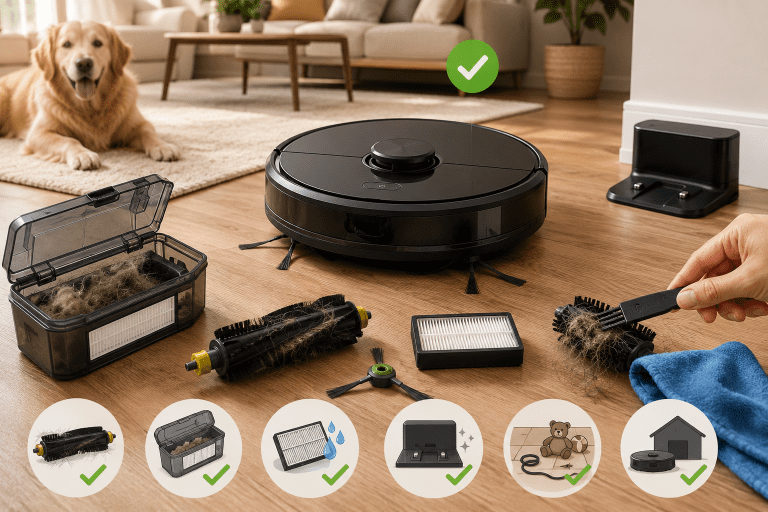
A robot operating with a clean filter consistently outperforms the same robot with a dirty filter, sometimes significantly. This is why filter maintenance belongs on a weekly schedule, not a monthly one.
The Pa Arms Race: What’s Actually Been Happening
Between 2022 and 2026, premium robot vacuum suction specs went from approximately 5,000 Pa to 35,000 Pa — a seven-fold increase in four years. Cleaning performance has not improved by anything close to that magnitude. What happened is a marketing competition, not an engineering revolution.
Pa became the easiest specification to inflate and the easiest for consumers to compare. Unlike navigation quality, brush agitation efficiency, or airflow design — which require hands-on testing to evaluate — Pa is a single number that looks decisive on a spec sheet. Brands found that higher Pa numbers sold products, and the competitive response was predictable: every brand raised its numbers.
Independent testing from sources like Vacuum Wars, which has tested over 150 models using standardized protocols, shows that real-world carpet cleaning performance demonstrates genuine but clearly diminishing returns above 6,000–7,000 Pa. The jump from 2,000 Pa to 6,000 Pa produces meaningful, visible performance differences. The jump from 15,000 Pa to 30,000 Pa, on the same carpet, produces results that are marginal at best and sometimes indistinguishable.
At extreme Pa levels, the robot vacuum’s internal duct system physically cannot flow enough air to utilize the full motor capacity. The suction power is there; the airpath can’t use it. Think of a high-performance engine in a car with a governor limiting its top speed — the potential exists, but the system has a ceiling that the spec number doesn’t reflect.
There’s also a secondary problem: Pa ratings for robot vacuums are not standardized across manufacturers. Unlike Air Watts, which are measured according to the IEC 60312 international standard, robot vacuum Pa ratings are measured by the manufacturer under manufacturer-defined conditions. A 10,000 Pa rating from Roborock and a 10,000 Pa rating from Dreame are not certified apples-to-apples comparisons. Some brands measure at the inlet, some at the motor, and some under conditions that maximize the number for marketing purposes.
Peak Pa vs. Operating Pa: The Number You’re Actually Living With
The Pa number on the box is the maximum — what the motor achieves in full boost mode under test conditions. In daily use, your robot operates at substantially lower power levels.
Most robot vacuums run in three modes:
Eco or Quiet Mode operates at roughly 40–60% of peak Pa, used for light surface cleaning and battery conservation. Quieter, longer battery run time, lower debris pickup on carpet.
Standard or Auto Mode operates at 60–75% of peak Pa, which is the default daily-use setting for scheduled cleaning runs. This is the power level you’ll experience in the vast majority of actual cleaning cycles.
Max or Boost Mode operates at 100% of peak Pa. On many models this activates automatically when the robot detects carpet (carpet boost), and can also be triggered manually for specific problem areas. This is the mode the advertised Pa number refers to.
What this means practically: two robots with different peak Pa ratings but similar standard-mode suction will clean equivalently across 90% of your daily runs. The peak Pa only creates a performance difference during carpet boost and deliberate max-mode cleaning — which, for most households, is a fraction of total operating time.
Before buying a robot vacuum based on Pa, it’s worth checking reviews that specifically address standard-mode cleaning performance rather than peak-mode benchmarks. Standard mode is what cleans your floors every day.
How Many Pa Do You Actually Need?
Here is the straightforward, floor-type specific answer — the part most spec sheets and comparison articles bury in vague generalities.
Hard Floors: Hardwood, Tile, LVP, Laminate
How much Pa you need: 2,000–4,000 Pa
Hard floor cleaning is primarily a brush roll and airflow task. You’re lifting surface debris — dust, crumbs, pet hair, tracked-in particles — that sits on top of the floor, not embedded in fibers. Even modest suction is adequate when paired with a rubber brush roll and decent airflow design.
More importantly: excessive suction on hard floors is counterproductive. At very high Pa levels on smooth surfaces, the robot creates strong downward pressure (negative pressure pulls the robot toward the floor), which can cause drag, reduce navigation speed, and scatter lightweight debris like fine dust before it can be captured. A robot running at 15,000 Pa on hardwood is using power that actively works against it on that surface.
If your home is primarily hard floors, the Pa number is genuinely one of the least important specs to evaluate. Focus instead on brush roll softness (avoiding scratching), edge cleaning quality, and whether the robot includes mopping capability.
Low-Pile Carpet: Up to 8mm Pile Height
How much Pa you need: 3,000–6,000 Pa
Low-pile and commercial-grade carpet has relatively shallow fibers, and everyday debris sits close to the surface. A robot vacuum in the 4,000–6,000 Pa range with a quality rubber brush roll handles daily maintenance on low-pile carpet thoroughly and reliably.
This is the floor type where mid-range robot vacuums perform most impressively relative to their cost. A $400–$600 robot in the 4,000–6,000 Pa range will leave your low-pile carpet genuinely clean after each run. Paying significantly more for higher Pa on low-pile carpet returns very little measurable benefit.
Medium-Pile Carpet: 8–12mm Pile Height
How much Pa you need: 5,000–8,000 Pa
As pile height increases, debris embeds more deeply in the fibers and requires more suction force combined with brush agitation to extract it. A robot in the 6,000–8,000 Pa range with carpet boost mode activated handles medium-pile carpet reliably for typical household debris loads.
At this level, the carpet boost feature becomes meaningful. Carpet boost is automatic suction increase when the robot detects it has moved from hard floor to carpet, ensuring the machine doesn’t clean carpet at hard-floor power levels. Verify any robot you’re considering for medium carpet explicitly offers this feature.
Thick or High-Pile Carpet: 12mm+ Pile Height
How much Pa you need: 10,000 Pa minimum; 12,000+ Pa recommended
This is the one scenario where higher Pa ratings genuinely earn their cost. On thick carpet, debris embeds several millimeters below the surface in dense fibers, and meaningful extraction requires both strong suction and a powered rubber brush roll pressing firmly against the pile with enough agitation to work debris loose.
Below 10,000 Pa on thick carpet, you’ll notice the robot cleaning the top layer of the pile without extracting what’s embedded beneath. At 10,000–15,000 Pa with a quality brush roll, extraction improves substantially. Above 15,000 Pa on most thick carpets, diminishing returns set in — the additional Pa is exceeding what the floor contact and airpath can effectively utilize.
If your home has significant thick carpet coverage, this is the scenario that genuinely justifies a higher Pa rating and the cost that comes with it.
Pet Hair
How much Pa you need: 3,000–4,000 Pa on hard floors; 6,000–10,000 Pa on carpet
Pet hair is where brush roll design and suction need to work in tandem, and where the brush roll specification matters at least as much as Pa.
On hard floors, pet hair sits on the surface and moderate suction with a rubber brush roll captures it effectively. The rubber brush roll is the critical variable here — it channels hair toward the suction inlet rather than wrapping it. On carpet, pet hair embeds in fibers and needs both agitation and stronger suction to extract.
For heavy-shedding households on carpet, 8,000–10,000 Pa with an anti-tangle rubber brush roll is the practical specification to target. For hard-floor pet households, 3,000–4,000 Pa with rubber extractors is more than adequate.
The Quick Reference Guide
| Floor Type | Pa Range Needed | What Matters More Than Pa |
|---|---|---|
| Hardwood / tile / LVP | 2,000–4,000 Pa | Rubber brush roll, mopping capability |
| Low-pile carpet | 3,000–6,000 Pa | Brush roll quality, carpet boost |
| Medium-pile carpet | 5,000–8,000 Pa | Carpet boost mode, rubber brush roll |
| Thick/high-pile carpet | 10,000–15,000 Pa | Brush agitation + suction combined |
| Pet hair on hard floors | 2,000–4,000 Pa | Anti-tangle rubber brush roll |
| Pet hair on carpet | 6,000–10,000 Pa | Anti-tangle brush + suction together |
Three Pa Myths Worth Putting Down
Myth: Higher Pa always means better cleaning. The evidence consistently shows otherwise. A well-engineered 6,000 Pa robot with quality airflow design, a rubber brush roll, and clean filter outcleans a poorly designed 18,000 Pa machine on most surfaces. Engineering quality determines how effectively Pa translates to the floor.
Myth: Pa ratings are standardized and comparable across brands. They are not. Unlike Air Watts, which follow the IEC 60312 international measurement standard, robot vacuum Pa ratings are manufacturer-measured under manufacturer-defined conditions. Comparing Pa numbers across brands is not a reliable apples-to-apples exercise.
Myth: You should always buy the highest Pa you can afford. For most homes, buying Pa above your floor type’s threshold is paying for capability you’ll never meaningfully use — and may actually work against you on hard floors where excessive suction creates drag and scatters lightweight debris.
What to Use Instead of Pa When Comparing Robots
Since Pa is an unreliable sole indicator, here’s what actually predicts real-world performance:
Independent test results. Sites like Vacuum Wars test robots with standardized debris loads on specific surfaces and report actual pickup percentages. A robot achieving 90% carpet deep-clean in independent testing tells you more than its Pa rating. Use these numbers when you can find them.
Brush roll specification. Rubber extractors and rubber dual-roller systems handle carpet, pet hair, and hard floors better than bristle brushes in most real-world conditions. This single spec predicts everyday performance more reliably than Pa for the majority of households.
Carpet boost mode. Confirm the robot automatically increases suction when it detects carpet. Without this, the machine cleans carpet at the same power level as hard floors, which consistently underperforms regardless of peak Pa rating.
Standard mode reviews. Look for owner reviews and test results that specifically address performance in daily standard mode — not boost or max mode. Standard mode is what cleans your home 90% of the time.
The Bottom Line
Pa is a useful starting point. It gives you a rough indication of the motor’s suction capability and helps sort robots into broad performance tiers. But it is one factor in a four-factor system, it’s measured under conditions that don’t reflect your home, and the industry has inflated it to the point where the raw number is increasingly disconnected from what it’s supposed to represent.
For most homeowners, the practical guidance is simple: match the Pa tier to your floor type using the table above, then evaluate brush roll design, carpet boost capability, and independent test results to decide between models within that tier.
If you have hard floors or low-pile carpet — which describes the majority of homes — you need far less Pa than the marketing materials suggest. A mid-range robot in the 4,000–8,000 Pa range, with a quality rubber brush roll and LiDAR navigation, will clean your home thoroughly and leave you with money left over that high-Pa premium models would have spent on specs you don’t need.
If you have thick carpet or multiple heavy-shedding pets on carpet, 10,000–15,000 Pa with a quality anti-tangle brush roll is genuinely worth targeting. Beyond that, you’re paying for numbers rather than results.