Here’s something a lot of people get wrong when buying a robot vacuum: they pick based on brand name or price tag, not floor plan. And then they’re surprised when their shiny new bot gets confused in a two-bedroom apartment — or barely covers half a large house before dying.
The truth is, home size genuinely changes what you need from a robot vacuum. A robot vacuum for a small apartment has a totally different job than one meant to handle a big house with multiple rooms. This guide breaks down exactly what to look for in each case, so you’re not overpaying for features you don’t need — or under-buying and ending up frustrated.
Why Home Size Actually Matters
It’s not just about square footage. It’s about how the robot navigates, how long the battery lasts, and how often you have to intervene.
In a small apartment — say, under 800 square feet — most robot vacuums can handle a full clean in one charge, even budget models. The layout is usually simpler, fewer rooms to transition between, and less chance of the robot getting lost or stuck. What matters more in a smaller space is how well it fits under furniture, how quiet it runs (especially if you’re working from home), and how compact it is for storage.
In a large home, you’re dealing with a completely different set of challenges. You need a strong battery, ideally with auto-recharge and resume — where the robot goes back to its dock when low, charges up, and then picks up exactly where it left off. Navigation matters a lot more too. Without solid mapping, a robot in a large home will overlap areas it’s already cleaned and miss others entirely.
What to Look for in a Robot Vacuum for Small Apartments
For smaller spaces, you don’t necessarily need to spend a lot. A few things actually matter more than others:
Slim profile. In apartments, furniture tends to be closer together and lower to the ground. A robot that’s a bit thinner — around 2.8 to 3.5 inches — will get under sofas and bed frames that taller models can’t reach.
Low noise output. Apartments have thinner walls and sometimes shared floors. A quieter motor (around 55–65 dB) is worth looking for, especially if you run it during the day.
Obstacle detection. Apartment living often means more stuff on the floor — shoes, cables, bags. A model with decent object avoidance saves a lot of hassle. The iRobot Roomba i3 and Eufy RoboVac 11S are solid picks here — practical, reliable, and priced reasonably for smaller spaces.
You probably don’t need advanced multi-floor mapping or extended battery life for a studio or one-bedroom. Save your money for features you’ll actually use.
What to Look for in a Robot Vacuum for Large Homes
This is where the specs really start to matter. A robot vacuum for a large home needs to be a bit more capable across the board.
Battery life and auto-resume. Look for at least 120 minutes of runtime, ideally more. More importantly, make sure it has auto-recharge and resume functionality. Without it, you’ll come home to a half-cleaned house every time.
Smart mapping with multi-room support. High-end models use LiDAR or camera-based mapping to create a floor plan of your home. This lets you set room-specific cleaning schedules, virtual no-go zones, and cleaning order. The Roborock S8 Pro Ultra and Dreame L20 Ultra do this well, handling large open floor plans without constantly backtracking or missing corners.
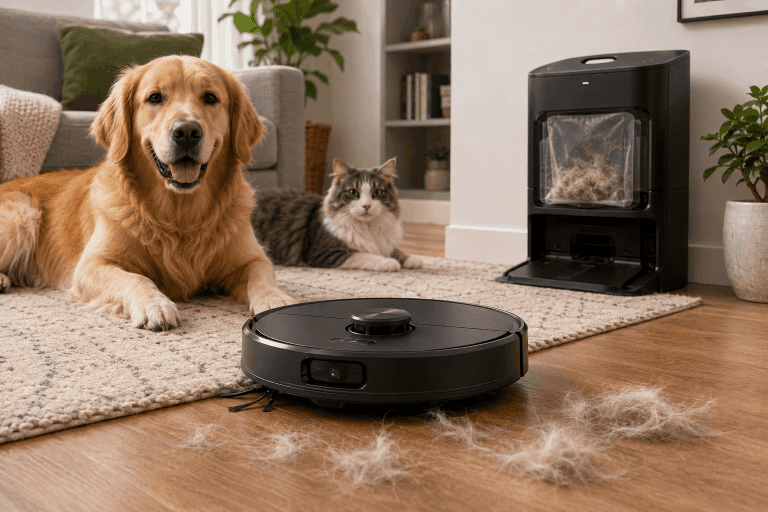
Strong suction and self-emptying base. Larger homes collect more debris — pet hair, dust, tracked-in dirt. A self-emptying base means you’re not emptying the dustbin every single run. For homes over 2,000 sq ft, this goes from “nice to have” to basically essential.
Mopping capability. If you have hardwood or tile across a large area, a combo vacuum-mop robot saves a lot of time. Just make sure it has a proper separation system so it doesn’t drag a wet mop onto carpet.
The Budget Factor: Where to Spend and Where to Save
Spending more doesn’t always mean getting more — it depends on your space.
For a small apartment, a $150–$300 robot vacuum will handle the job well. Spending $800 on advanced mapping for a one-bedroom is overkill. You’ll never use half the features.
For a large home, budget at least $400–$600 for a reliable model, and $700+ if you want the full package — self-empty base, mopping, precise mapping. Skimping here tends to backfire: cheap robots in large homes either miss sections repeatedly or need constant supervision, which defeats the purpose.
One middle-ground option worth mentioning: if you have a medium-sized home (1,000–1,800 sq ft), something like the Shark Matrix or Roborock Q5+ hits a good balance between coverage and cost.
A Quick Side-by-Side Comparison
| Feature | Small Apartment | Large Home |
|---|---|---|
| Battery life needed | 60–90 min | 120+ min with auto-resume |
| Mapping | Basic or none | LiDAR/multi-room required |
| Self-empty base | Optional | Recommended |
| Budget range | $150–$350 | $400–$900+ |
| Key priority | Slim fit, quiet | Coverage, smart navigation |
Choosing a robot vacuum isn’t really about finding the “best” one overall — it’s about finding the right fit for your specific space. For a small apartment, you want something slim, quiet, and affordable that handles your layout without getting stuck. For a large home, you’re prioritizing runtime, smart mapping, and ideally a self-emptying base that keeps things running with minimal input from you.
Before you buy, measure your space, think about your floor types, and be honest about how much you want to babysit the thing. The best robot vacuum is the one that fits how you actually live — not just the one with the most impressive specs sheet.
If you’re still unsure, start with your home’s square footage and work from there. That single number will narrow your options faster than any other filter.