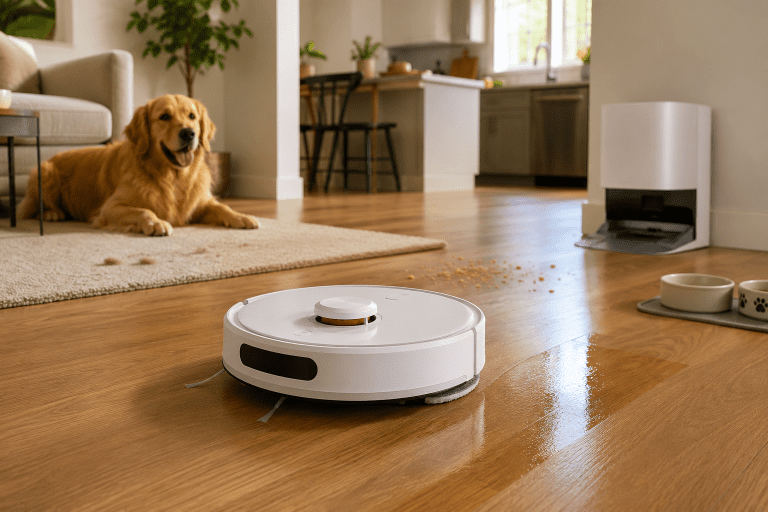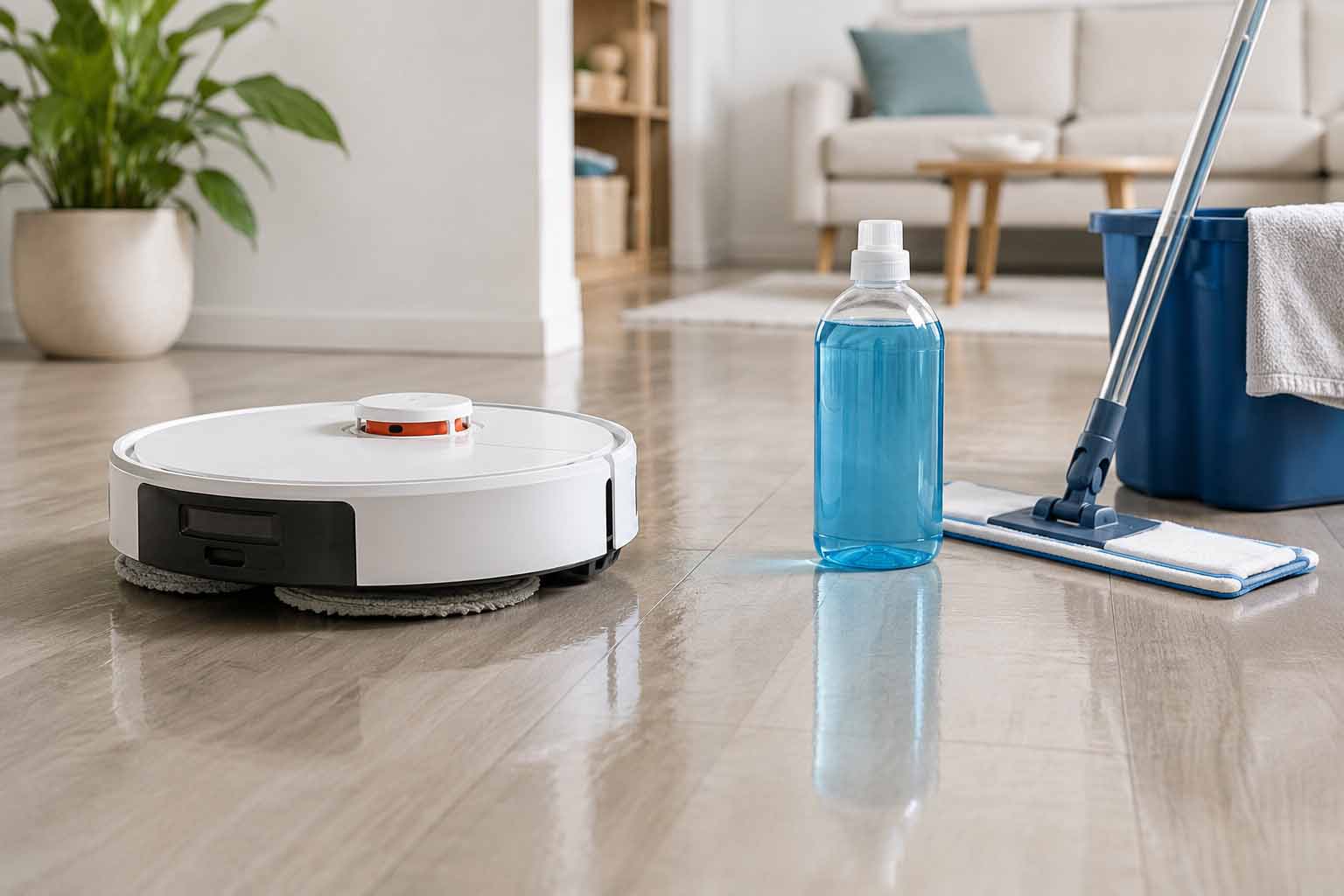
Once you own a robot vacuum with mopping capability, a question arrives quickly: what exactly goes in the water tank?
Plain water works, and for many households it works well enough. But if you want genuinely clean floors — not just damp floors — the right cleaning solution makes a real difference. The challenge is that robot vacuum water systems are nothing like a mop bucket, and what’s safe and effective in one context is potentially damaging in the other.
The wrong solution in a robot mop can clog internal sensors, corrode rubber seals, foam up and damage the water pump, leave sticky residue on your floors, and in some cases void your warranty. The right solution — properly diluted and matched to your floor type — cleans effectively, dries quickly, and leaves your floors streak-free without harming the machine.
This guide covers everything you need to know: why regular floor cleaners and popular DIY mixtures are a problem, what makes a cleaning solution robot-mop safe, which specific products work well in 2026, and how to match your solution to your floor type.
Why you can’t just use any floor cleaner
This surprises many new owners. You have a perfectly good floor cleaner under the sink. It cleans floors. Why can’t it go in the robot?
The answer comes down to three things: foam, residue, and chemistry.
Foam. Standard floor cleaners and dish soaps are formulated for bucket-and-mop use, where foam simply sits in the bucket and gets wrung out. In a robot vacuum’s water system, foam has nowhere to go. It builds up in the water pump, forces its way into internal channels, and can cause the pump to work harder, overheat, or fail entirely. Avoid all-purpose floor cleaners, soaps, and bleach — they can foam excessively and damage pumps or seals.
Residue. Many household floor cleaners leave a light residue on floors that’s invisible after a manual mop-and-rinse. In a robot system that deposits a very fine layer of solution without rinsing, that residue builds up on the floor surface with every pass, eventually creating a dull, sticky film that attracts dirt rather than repelling it.
Chemistry. The internal components of a robot vacuum’s water system — rubber seals, plastic tanks, metal pump components, sensors — are designed for water and specifically formulated robot-safe solutions. Common household products can seriously damage your robot vacuum: vinegar can slowly eat away at rubber seals and metal parts; essential oils and soaps can clog spray nozzles and make the tank brittle; bleach and strong cleaners are corrosive and can destroy delicate internal components; and regular floor cleaners are designed for buckets and can foam up and jam the water pump.
Beyond machine damage, using solutions that aren’t authorised may void your warranty, leaving you without any protection if your device breaks.
The vinegar question
Vinegar is the most commonly asked-about alternative, and the answer requires some nuance.
The appeal is obvious: white vinegar is inexpensive, natural, cuts through residue, and is genuinely effective at cleaning hard floors when used manually. Many homeowners use it regularly with no problems.
In a robot mop, the situation is different. Vinegar is a corrosive liquid that can damage the internal parts of your robot mop, including the sensors, motors, and other electronic parts. Also, vinegar can damage the water tank and other plastic parts of the mop. More specifically, using vinegar in devices with rubber gaskets will destroy the gaskets over time, and gradually, vinegar will chip away at the glue that secures the treads to the wheels.
Some manufacturers allow a very diluted vinegar solution — eufy notes that a 30:1 water-to-vinegar ratio is acceptable if their proprietary solution is unavailable. But this is brand-specific guidance for specific models, and even where it’s permitted, it’s a fallback rather than a recommendation.
The practical advice: if you want to use something other than plain water in your robot mop, use a specifically formulated robot-mop cleaning solution rather than improvising with household alternatives. The cost difference is minimal and the protection for your machine is meaningful.
What makes a solution robot-mop safe
Before getting into specific products, it helps to understand what properties to look for. Any solution you put in a robot mop water tank should meet all of these criteria:
Low-foam or no-foam formula. This is the most important mechanical requirement. The solution must not generate foam inside the water system. Products specifically designed for robot mops are formulated to be non-foaming or ultra-low-foam.
pH-neutral. A pH-neutral formulation (pH 6.5–7.5) is safe for sealed hard floors — hardwood, tile, stone, vinyl, laminate — without risk of dulling finishes or reacting with floor coatings. Solutions outside this range, particularly acidic ones, can damage floor finish over time.
Quick-drying. Robot mops apply a fine film of solution that should evaporate quickly. A slow-drying solution leaves more moisture on the floor for longer, which is a concern for hardwood in particular.
No sticky residue. The solution should dry to a clean, residue-free surface. Sticky residue from the wrong cleaner builds up with each daily run, creating a film that actually makes floors look worse over time.
Compatible with your machine’s internal components. This means no harsh solvents, no strong acids or alkalis, no essential oils and no surfactant levels that will damage rubber or corrode metal parts.
Your options: a clear hierarchy
Option 1: Manufacturer’s own solution (most reliable)
Every major robot vacuum brand sells a cleaning solution designed specifically for their water systems. These are the safest choice for your machine because they’re formulated for and tested with its exact components.
Roborock Floor Cleaning Solution is formulated specifically for Roborock models with mopping capability, including the Saros and Qrevo series. It’s a concentrate diluted at a 1:200 ratio — one bottle goes a very long way. pH-neutral, low-foam, safe on sealed hardwood, tile, stone, vinyl, and laminate. Produces a streak-free result and is recommended as the first-choice solution for any Roborock mopping system.
eufy Cleaning Solution is specifically designed for eufy robot vacuum mop models. It’s pH-balanced, residue-free, and formulated to be safe for internal water channels. eufy also notes that if their solution isn’t available, plain distilled water is the recommended fallback.
iRobot / Roomba solutions are model-specific. For the Roomba Combo series, iRobot has officially approved Bona Hardwood Floor Cleaner and Bona Hard Surface Floor Cleaner for use in some models — though notably, these caused excessive sudsing in the Roomba Combo 10 Max, so model-specific approval matters. Always check the official iRobot support page for your exact model before using any solution.
Dreame and Ecovacs / DEEBOT both offer brand-specific solutions for their mopping-capable models and recommend against using anything not explicitly approved for the specific model in question.
The case for sticking with manufacturer solutions: you know they work with your machine, they’re covered by manufacturer support if something goes wrong, and they don’t risk warranty issues. The case against: they tend to be the most expensive per litre, and they’re only available through brand channels rather than general retail.
Option 2: Third-party robot-mop-specific concentrates (excellent value)
A category of cleaning concentrates has emerged specifically designed for robot mop water tanks — not adapted from household floor cleaners, but formulated from the start with robot vacuum system requirements in mind. These products are often significantly more economical than manufacturer solutions and in several cases perform equivalently.
For 2026, WoldoClean Floor Cleaner Solution for Robot Mops is a good third-party recommendation. The highly concentrated formula makes up to 40 gallons of liquid — you only need a few drops per cleaning. The low-foam mix protects the internal sensors and pumps of the machine, quickly dissolves tough grime without leaving sticky residue, and produces a streak-free shine on tile and hardwood. The pet-safe formula neutralises bad odours, and the gentle pH-neutral washing fluid is safe for all sealed surfaces including stone, vinyl, laminate, and wooden floors.
WoldoClean also produces a wood-specific variant — the WoldoClean Wood Floor Cleaner for Robot Mops — which is pH-neutral, safe for sealed floors including hardwood, tile, stone, vinyl, and marble. It dries quickly with a streak-free shine and fresh scent, leaving no sticky residue and requiring no rinsing. The wood-specific formula has additional conditioning properties that help maintain wood grain appearance.
Both WoldoClean products are compatible with Roborock, Dreame, Roomba, Tineco, Eufy, Shark, and Bissell systems. A 25 oz bottle produces 75–150 cleaning cycles depending on dilution, making the per-clean cost very low.
Roboshine by FILA Surface Care Solutions is designed for all robot vacuum and mop combo systems and wet-dry vacuums. Hard floor cleaner formulated for tile, stone, vinyl, laminate, and sealed hardwood. Low-foam, streak-free, and designed to work within robot water delivery systems.
Aolleteau Floor Cleaner is a concentrate compatible with Roborock, Eufy, Dreame, and iRobot models. Available in standard and larger formats, pH-neutral, suitable for daily use on all sealed floor types.
When choosing a third-party product, verify that it explicitly states it is formulated for robot mop systems — not just that it works on floors. The former means the foaming behaviour was specifically engineered for robot water pumps; the latter means it was tested on floors using traditional methods, which is a different standard.
Option 3: Plain distilled water (always safe, always acceptable)
If you’re unsure about any cleaning solution, or if your floor type is sensitive, plain distilled water is always a safe choice. It cleans light everyday debris and surface dust effectively when applied by a robot mop running daily.
The reason distilled is preferable to tap water: tap water contains minerals that deposit on the floor surface and inside the machine’s water channels over time. In hard water areas, these mineral deposits can gradually clog spray nozzles and reduce water flow. Distilled water avoids this entirely.
For hardwood floors where any cleaning solution raises moisture concerns, distilled water in the robot mop at the lowest moisture setting is the most conservative and completely safe approach.
Matching your solution to your floor type
Not all solutions suit all floor types equally, and the floor type in your home should shape your choice.
Sealed hardwood and engineered hardwood
Best choice: pH-neutral, quick-drying, low-moisture formula. WoldoClean Wood Floor Cleaner for Robot Mops or your robot manufacturer’s own hardwood-approved solution.
Key requirements: pH-neutral is essential — acidic or alkaline solutions can dull polyurethane finish over time. Quick-drying is important because hardwood is more sensitive to moisture than tile or vinyl. Use the lowest moisture setting on your robot regardless of which solution you choose.
Avoid entirely: Vinegar (even diluted), anything with strong cleaning agents, standard floor cleaners not explicitly rated for hardwood. For older hardwood with oil or wax finish rather than polyurethane, disable the mop function entirely and clean manually with a wood-specific product.
Tile and grout
Best choice: pH-neutral multi-surface formula. Both manufacturer solutions and third-party robot mop concentrates handle tile well.
What to know: Grout is the main challenge on tiled floors, and a robot mop will address surface grout cleaning but won’t reach embedded staining in heavily discoloured grout. That requires manual scrubbing with a grout-specific cleaner as part of a periodic deep clean. For day-to-day grout surface maintenance, the robot mop running daily prevents the buildup that leads to deep staining.
For natural stone tile — marble, travertine, slate — pH-neutral is critical. Highly acidic cleaners like undiluted vinegar can damage natural stone like marble and granite. Use only pH-neutral, stone-safe formulas on natural stone tile.
Luxury vinyl plank (LVP) and laminate
Best choice: Any pH-neutral, residue-free robot mop formula works well on LVP and laminate. These are among the most forgiving floor surfaces for robot mopping.
Key concern for laminate specifically: Moisture. Laminate has a wood-composite core that can swell if moisture penetrates the edges of planks. Use the lowest moisture setting and ensure your solution dries quickly. The primary risk for laminate from robot mopping is if a robot leaks or stays on a laminate seam too long — the moisture can cause the core to swell, leading to peaking at the edges.
Mixed floors
If your home has multiple floor types, a universal pH-neutral formula that’s safe across hardwood, tile, vinyl, and laminate eliminates the need to change solutions between areas. WoldoClean’s multi-surface formula and most manufacturer solutions fall into this category.
If your home has areas where specific floor types need different treatment — unsealed wood, natural stone, highly polished marble — consider setting no-go zones in your app to keep the robot off those areas and address them manually with appropriate products.
What you should never put in a robot mop water tank
This deserves its own clear section because the consequences are real and sometimes irreversible.
Vinegar (undiluted or lightly diluted): Corrodes rubber seals and gaskets, chips away at wheel adhesives, and can damage internal metal components over time.
Essential oils: Even a few drops can clog spray nozzles and cause residue buildup inside the tank and on floors. They don’t rinse cleanly from robot water systems.
Dish soap or regular detergent: Will foam excessively in the pump system. Even small amounts cause problems.
Bleach or bleach based cleaners: Too aggressive for daily floor contact and very corrosive to internal parts.
Pine-Sol and similar oil-solvent cleaners: Pine-Sol contains oils and solvents that can leave residue inside the tank and on floors. Over time, this can clog sensors and reduce suction power.
Disinfectants (Lysol, Dettol, etc.): Not suitable for use in robotic water systems. Most are too strong to be used automatically on a daily basis and some have chemical makeups that react badly with robot water system parts.
Tap water in hard water areas (as a long-term choice): Not immediately harmful, but mineral deposits accumulate in nozzles and channels over time. Use distilled water as standard practice for better long-term machine health.
How to use cleaning solutions correctly in your robot mop
Even the right solution causes problems if it’s used incorrectly. A few practices make a real difference.
Always add water before concentrate. Adding concentrate to the tank first, then water, can cause foaming during the filling process. Add your water first, then add the required amount of concentrate.
Dilute accurately. Robot mop concentrates are highly concentrated — WoldoClean, for example, requires only 5–10ml per 300ml of water. Using more than the specified dilution doesn’t clean better. It leaves more residue and uses up your supply faster. Follow the dilution ratio on the label precisely.
Empty and rinse the tank after each use. Solution left sitting in the water tank between cleaning sessions can degrade, leave residue, or in some environments allow bacterial growth. Empty any remaining solution after each session, rinse the tank with clean water, and refill fresh for the next run.
Check your specific model’s approved list. Even within brands, some models have different water system designs that affect which solutions are safe. A solution approved for the Roborock Saros 10 may not be listed for the S8 Max Ultra. When in doubt, check your model’s manual or the brand’s support page for approved solutions.
Match moisture level to floor type. The best solution in the world won’t compensate for excessive moisture on hardwood. Always pair your solution choice with the appropriate moisture setting on your robot — lowest for hardwood, moderate for tile and vinyl, higher only where your floor type genuinely tolerates it.
Quick reference guide
| Floor type | Recommended solution | Avoid |
|---|---|---|
| Sealed hardwood | pH-neutral, wood-specific robot formula or distilled water | Vinegar, regular floor cleaners, anything acidic |
| Engineered hardwood | pH-neutral robot formula, lowest moisture setting | Excess moisture, acidic cleaners |
| Tile (ceramic/porcelain) | pH-neutral multi-surface robot formula | Bleach, abrasive cleaners |
| Natural stone tile | pH-neutral only, stone-safe confirmed | Vinegar, acidic cleaners, anything not stone-rated |
| LVP / luxury vinyl | Any pH-neutral robot formula | Excess moisture on laminate edges |
| Laminate | pH-neutral robot formula, lowest moisture setting | Any solution that dries slowly, excess water |
| Mixed floors | Universal pH-neutral robot formula safe on all sealed surfaces | Solutions specific to only one surface type |
The bottom line
The safest and most reliable starting point is always your robot vacuum manufacturer’s own cleaning solution — it’s tested for your exact machine and floor types, and it protects your warranty. For homeowners who want better value without compromising safety, third-party concentrates specifically formulated for robot mop systems — particularly WoldoClean and similar dedicated products — deliver equivalent performance at significantly lower cost per clean.
Plain distilled water is always a safe fallback and is genuinely sufficient for light daily maintenance on most floor types.
What’s not safe is improvising with household floor cleaners, vinegar, dish soap, or essential oils — no matter how effective they might seem for manual mopping. Robot water systems are precision components, and the wrong chemistry damages them in ways that are expensive, sometimes irreversible, and often not covered under warranty.
Match your solution to your floor type, dilute accurately, and rinse the tank after each use. Done consistently, this simple routine keeps both your machine and your floors performing at their best.