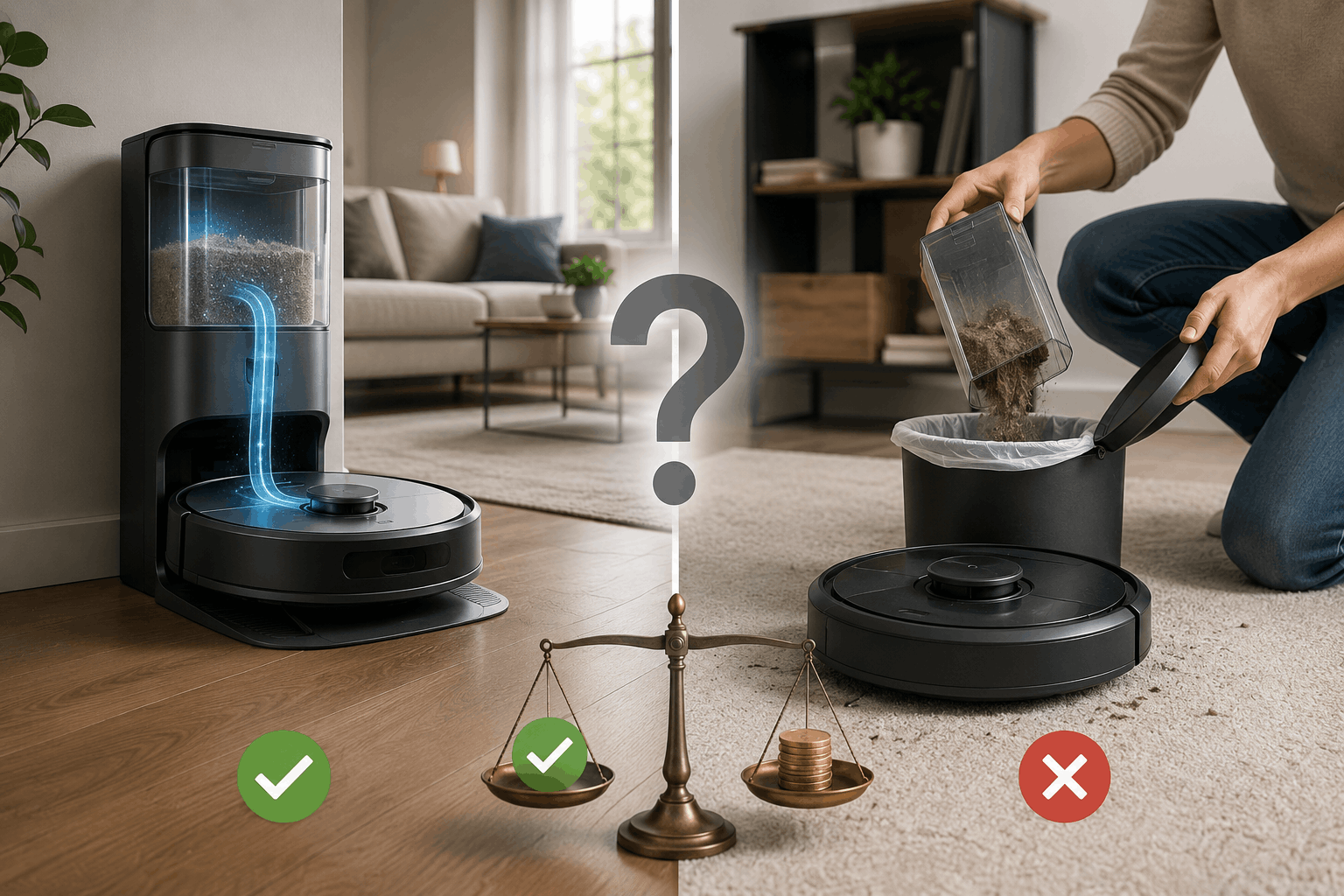
If you’ve been shopping for a robot vacuum for more than ten minutes, you’ve probably noticed that models with self-emptying docks cost significantly more than those without — typically $150 to $300 more for otherwise comparable machines. The question of whether that premium is justified is one of the most common things people ask before buying.
The short answer is: for most households, yes. But the longer answer depends on how you’ll actually use the machine, how much you dislike the alternative, and what your specific home situation looks like.
What a self-emptying dock actually does
When a standard robot vacuum finishes a cleaning run, it returns to its charging dock with a full dustbin. You then need to open the dustbin, empty it into a trash can, and replace it before the next run. On a machine running daily, this means a daily task that takes about 30 seconds — but 30 seconds every day adds up, and in practice, many people skip it, which causes suction to degrade.
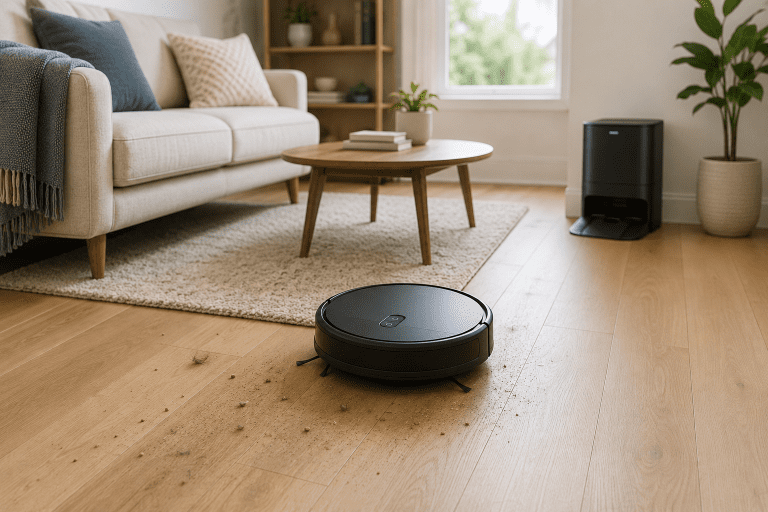
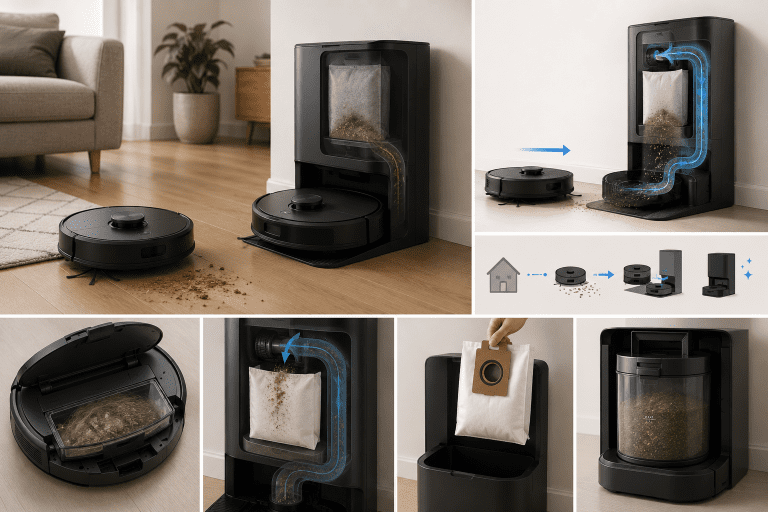
A self-emptying dock changes this. When the robot returns to its dock after cleaning, a powerful suction system in the dock pulls the contents of the robot’s small dustbin up into a larger bag inside the dock station. This bag — typically holding 30 to 75 days of debris — only needs replacing every few weeks. The process takes about 15–20 seconds and is automatic.
The practical result: you can run your robot daily for a month or more without doing anything to maintain it beyond the periodic bag replacement.
The genuine benefits
Longer maintenance cycles. This is the headline benefit. Instead of a 30-second daily task, you have a 2-minute monthly task. For busy households or anyone who finds maintenance chores easy to forget, this matters.
Better sustained suction. A full dustbin restricts airflow and reduces suction. Robots that empty automatically after each run are always starting the next run at full performance — something that’s very easy to neglect with a manual-empty model.
Allergy benefits. If anyone in your household has allergies or respiratory sensitivities, the way debris is emptied matters. Opening a dustbin and shaking it into a trash can releases a cloud of fine dust and dander into the air. A sealed self-empty bag contains everything until disposal, with minimal disturbance.
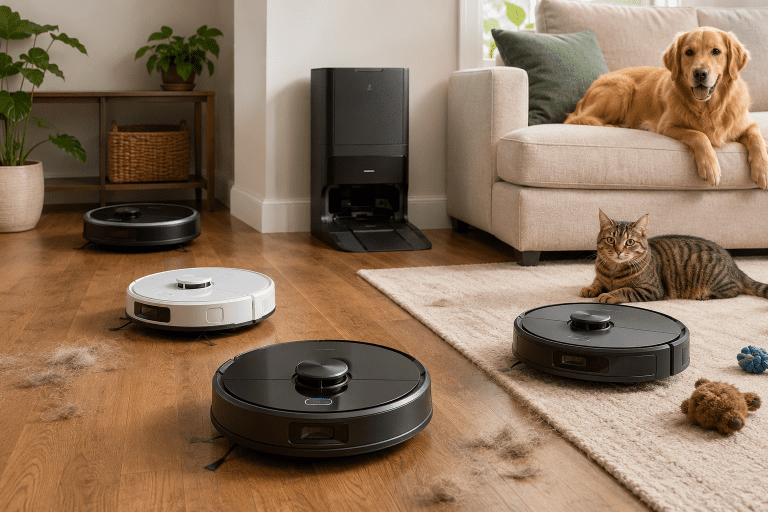
Pet households. For homes with shedding pets, a robot vacuum’s dustbin can fill within a single room of thick carpet. Running daily in a pet household without a self-emptying dock means emptying the bin every single run — or accepting reduced performance. Self-emptying removes this problem entirely.
The honest trade-offs
Ongoing cost. Replacement bags typically cost $5 to $15 each, depending on the brand and whether you use official or third-party bags. At monthly replacement, that’s $60 to $180 per year — a real running cost to factor into the total cost of ownership.
Dock size. Self-emptying docks are substantially larger than standard charging docks. The dock plus the bag system adds height and footprint. In smaller spaces — apartments, compact laundry rooms — this can be a genuine constraint.
The dock can be loud. The emptying cycle is noticeably louder than the robot itself — a brief 15–20 second burst of suction noise. If the dock is in a bedroom or in a space where noise sensitivity matters, this is worth knowing.
Who benefits most from self-emptying
Pet owners. This is the clearest case. A self-emptying dock is close to essential for households with moderate-to-heavy shedders. The combination of high-frequency runs and high debris volume makes manual emptying genuinely burdensome without it.
Allergy households. Sealed bag systems meaningfully reduce the allergen exposure during emptying compared to an open dustbin.
Busy households. If you want to truly set up a cleaning schedule and not think about the robot until something needs attention, self-emptying is what makes this possible.
People who know themselves. If you’re honest about the fact that you’ll forget to empty the dustbin half the time, a self-emptying dock prevents the performance degradation that follows.
Who can reasonably skip it
Smaller homes with minimal pet hair. A single person in a 600-square-foot apartment with hard floors and no pets generates enough debris to fill a dustbin every few days, not every run. Manual emptying takes seconds, costs nothing, and the running cost savings are real.
Budget-constrained buyers. If the choice is between a $300 non-self-emptying robot with good navigation and a $500 self-emptying robot with worse navigation, take the better robot. Good navigation producing thorough cleaning matters more than dock automation.
People who already maintain their appliances well. If you naturally build maintenance habits and won’t skip the daily 30-second emptying, the self-emptying premium may not change your experience meaningfully.
Bottom line
Self-emptying docks are worth the premium for most households — especially those with pets, allergies, or a genuinely busy schedule. The ongoing bag cost is real but modest, and the sustained performance improvement from always running with an empty dustbin is a practical benefit beyond the pure convenience.
For very small homes without pets, or buyers on a tight budget choosing between a better robot versus self-emptying capability on a lesser machine, the feature can reasonably be skipped.